The Tethered Beast: Decoupling Power from the Autonomous Field
Remarks from TPEX consultancy for decision makers.
Remarks from TPEX consultancy for decision makers.
Written SH on 2026-06-10.
Tagged remark agriculture automation energy
The electrification of heavy agriculture faces a brutal bottleneck that has nothing to do with torque, and everything to do with logistics. It manifests in a deceptively simple question: How do you charge an electric tractor in the middle of a hundred-acre field?
When operating a diesel machine, the solution is trivial. You drive a support truck out with a fuel bowser, pump liters of high-density liquid energy into the tank in minutes, and continue working. But electricity is heavy, slow to move, and bound by the physics of the grid. You cannot run an extension cord back to the farmhouse, and dragging a multi-ton machine back to the yard every four hours destroys field efficiency.
To solve the field-charging dilemma, agriculture must abandon the legacy “gas station” mental model—where a machine travels to a static fueling point—and embrace decentralized, mobile, and eventually autonomous energy distribution networks.
The immediate, friction-free transition relies on leveraging existing farm infrastructure to move the power to the machine, rather than the machine to the power.
Instead of waiting for a battery to charge, operators will treat the battery as a standardized, hot-swappable implement. High-capacity, weatherproof battery containers can be dropped at the field headland via a standard telehandler or flatbed trailer. When the tractor runs low, the operator drives to the edge of the field, drops the depleted module using a quick-release front or rear hitch, picks up a fresh unit, and engages a heavy-duty busbar connector.
This mechanical workaround keeps field downtime under ten minutes. Crucially, it isolates the grid connection; the spare packs can sit back at the farmyard, charging slowly throughout the day via localized solar arrays without spiking peak demand on rural infrastructure.
As battery capacities increase, the next evolution steps away from physical component swapping and toward localized generation using a towable “Solar Tender.”
This approach deploys a heavy-duty trailer outfitted with a high-capacity stationary battery buffer and a massive, fold-out solar photovoltaic (PV) array. Parked at the field margin ahead of time, this mobile substation quietly accumulates energy from both the sun and off-peak farmyard charging.
When the tractor requires a top-up—ideally aligning with necessary operator rest cycles or midday meal breaks—it pulls alongside the tender. Using an automated, ruggedized DC fast-charging connection, the tender blasts an 80% charge into the tractor within twenty to thirty minutes. By utilizing space that is already being worked, the farm creates a pop-up microgrid exactly where the energy is consumed, mitigating the need for expensive regional grid upgrades.
The final frontier arrives when we remove the human operator entirely, transforming the tractor and its power source from two separate entities into a single, self-correcting autonomous vehicle (AV) ecosystem.
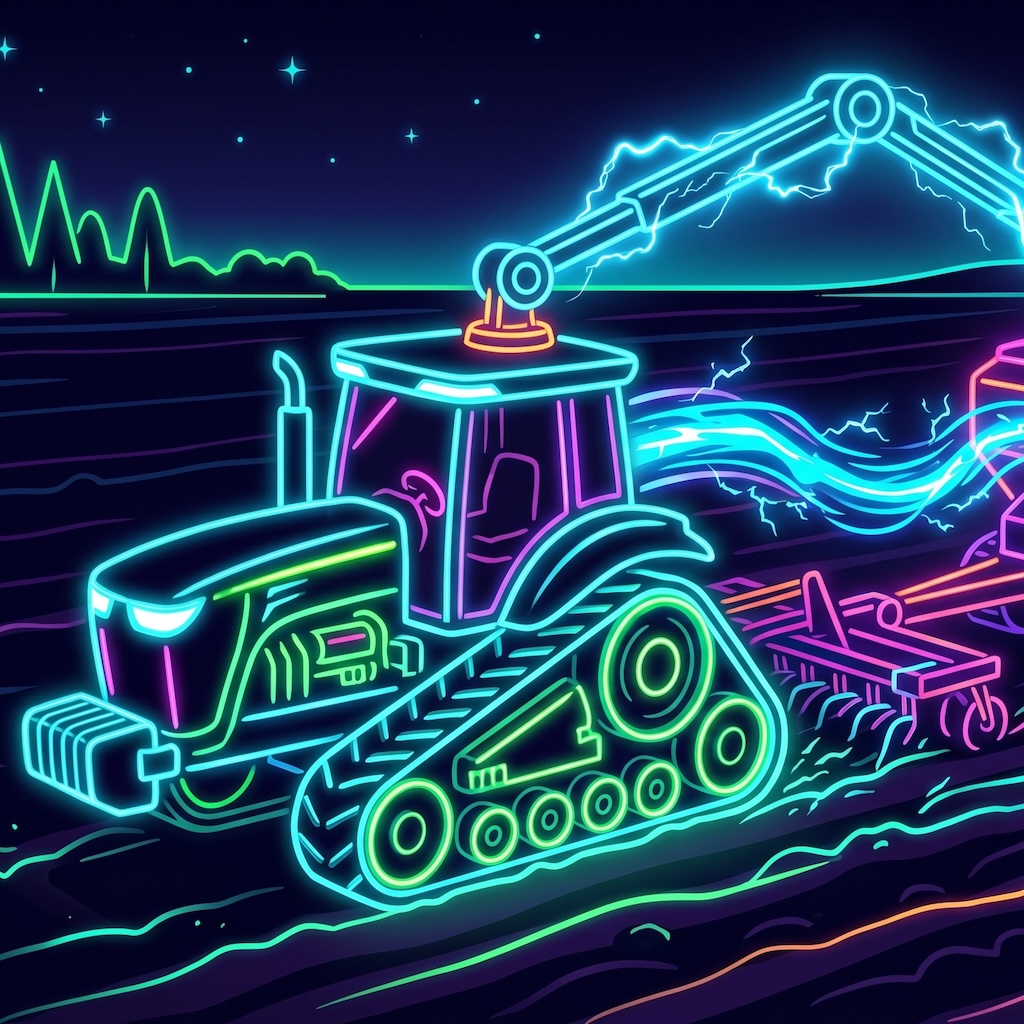
In a fully automated landscape, the AV tractor never stops working. It does not return to a dock; instead, the dock comes to the machine. When the tractor’s telemetry signals its capacity has dropped to 15%, a secondary autonomous support vehicle—a tracked “Power Tender” rover—departs the farmyard charging bay. Guided by GPS and LiDAR, it navigates directly to the active field and matches the tractor’s exact working speed.
An automated overhead arm or inverted pantograph deploys from the tender, locking onto the moving tractor via high-power DC induction or a magnetic coupling. The tender transfers its charge while the tractor continues to till, seed, or spray. Once the energy transfer is complete, the tender automatically detaches and returns to base to replenish its own reserves.
True agricultural automation is not achieved merely by removing the driver from the cab; it is achieved by removing the logistics of refueling from the human manager’s cognitive load. By treating power as a fluid dynamic within the field rather than a static destination, the farm transforms into a 24/7 autonomous ecosystem. The tractor never leaves the furrow, the soil is worked precisely when conditions are optimal, and the human role shifts entirely from operator to system architect.
TPEX thinks about the future.