Chronos-Arbitrage
Remarks from TPEX consultancy for decision makers.
Written SH on 2026-06-03.
Maya stepped out of the acceleration pod, her muscles trembling from disuse. Outside, the sun had barely moved—three hours of objective time—but she had lived forty-seven subjective days solving the proof that would secure her tenure. Her husband was still making breakfast, the same breakfast he’d started when she entered. He smiled at her with the patience of someone who’d learned to love a ghost, someone who flickered in and out of his timeline like a character from a half-remembered dream. She wanted to tell him about the breakthrough, about the elegant symmetry she’d discovered in week five of her deep dive, but the words felt heavy, translated across temporal borders he could never cross.
Down the street, protest signs flickered with slogans in real-time and time-compressed frequencies: “One Clock, One People” and “Temporal Justice Now.” The Baseline Movement had grown while she was under, their numbers swelling with those left behind in the slow lane of existence. Maya’s neighbor, an artist who refused acceleration on principle, stood among them—a man who had aged three hours while she had aged seven weeks of consciousness. He’d once told her that time was meant to be felt, not optimized, that the space between moments was where meaning lived. As she watched him now, carrying his slow-time convictions like a badge of honor, she wondered if perhaps he was living while she was merely accumulating—rich in hours but somehow poorer in the currency of presence.
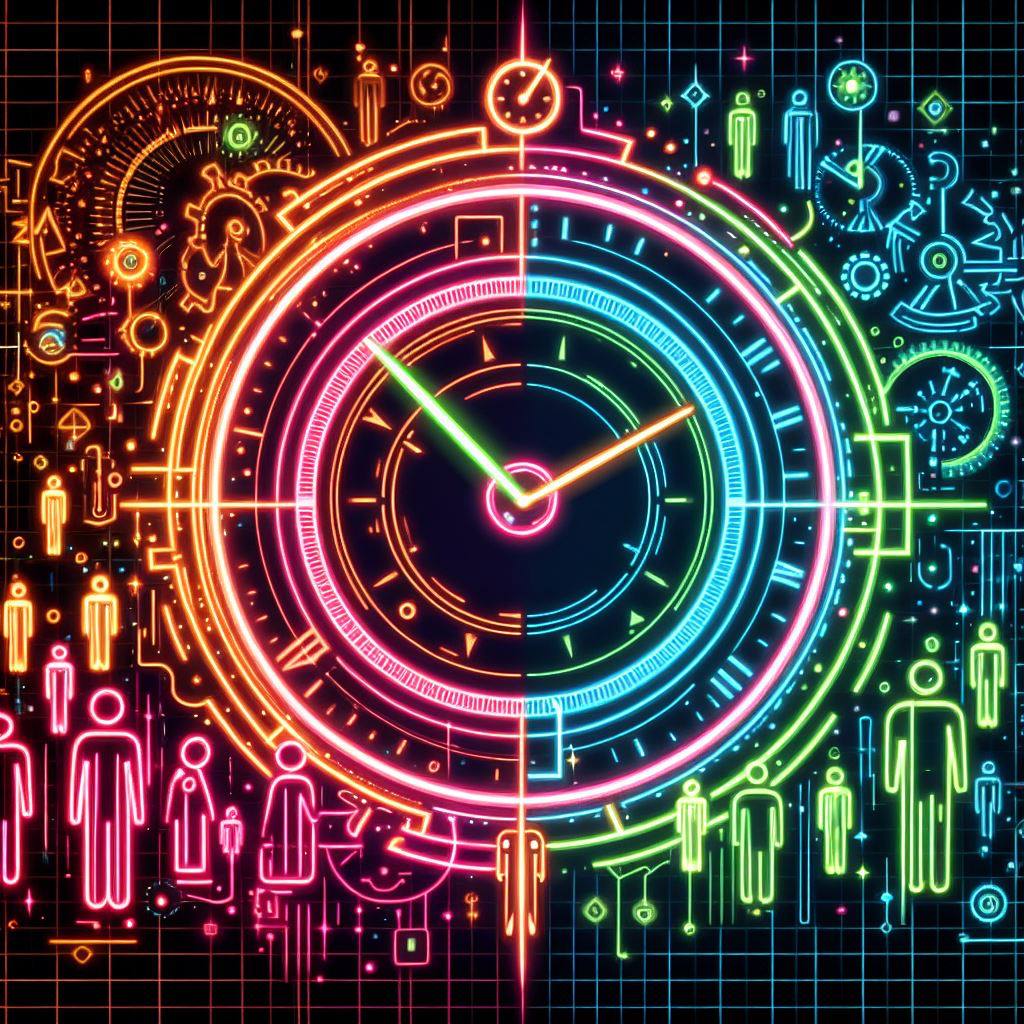
The emergence of commercially viable neural acceleration technology has precipitated an unprecedented fracture in humanity’s collective temporal experience. Current adoption patterns indicate that approximately forty percent of knowledge workers now regularly engage in subjective time dilation, experiencing between ten and fifty times the cognitive duration of their non-accelerated counterparts for identical objective periods. This bifurcation creates fundamentally incompatible modes of existence: one characterized by embodied, socially synchronized experience, and another defined by isolated cognitive hyper-extension. The implications extend far beyond productivity metrics—we are witnessing the formation of parallel civilizations occupying the same physical space but inhabiting radically different experiential universes. Social rituals, from shared meals to collective celebrations, lose coherence when participants exist at divergent temporal resolutions. The very notion of “contemporaneousness” dissolves when colleagues, families, and communities can no longer agree on what constitutes a shared moment.
Access to neural acceleration has crystallized into the defining axis of social inequality in the mid-21st century. While traditional wealth disparities persist, temporal inequality represents a more insidious form of stratification—one that compounds exponentially with each accelerated session. An individual with unrestricted access to time dilation can accumulate ten years of subjective learning and professional development in a single objective year, creating competency gaps that conventional education cannot bridge. This temporal privilege reproduces across generations, as children of accelerated parents inherit not merely wealth but access to subjectively extended childhoods, mentorship, and skill acquisition. Career trajectories diverge irrevocably: baseline-time professionals find themselves perpetually outpaced by competitors who have subjectively lived decades more experience. Romantic and familial relationships face unprecedented strain, as partners and relatives drift apart not through geographic distance but temporal desynchronization—aging at different subjective rates, accumulating incompatible volumes of experience, and ultimately inhabiting incommensurable life-histories.
The strategic exploitation of subjective-objective time differentials has emerged as the paramount competitive advantage across all sectors of human endeavor. Organizations now conduct critical negotiations, research initiatives, and strategic planning within accelerated environments, achieving in days what would require years of objective time for baseline competitors. This “chronos-arbitrage” creates winner-take-all dynamics in innovation, governance, and cultural production. Financial markets increasingly operate across temporal strata, with accelerated traders executing strategies informed by subjectively months of analysis between objective milliseconds. Governance structures struggle to accommodate citizens whose political engagement occurs at radically different temporal densities—some experiencing entire election cycles as brief interludes, others living them as extended civic dramas. The phenomenon raises existential questions about the nature of democratic deliberation and cultural continuity when portions of the population are, quite literally, living in fast-forward.
The proliferation of time-stream fragmentation threatens to dissolve the fundamental social substrate upon which human civilization has historically depended. Shared temporal experience has always been the invisible architecture of community—the synchronized rhythms of work and rest, celebration and mourning, that bind individuals into coherent social bodies. As this commons erodes, we face the prospect of a society fractured beyond repair: families unable to coordinate meaningful interaction, professional communities stratified by unbridgeable experience gaps, and democratic institutions rendered impotent by constituents who no longer inhabit the same temporal reality. The psychological toll on both accelerated and baseline populations manifests in epidemic levels of temporal dysphoria, relationship dissolution, and existential disorientation. Most concerning is the emergence of temporal tribalism, as accelerated and baseline populations develop mutually incomprehensible cultures, values, and worldviews—not through philosophical disagreement, but through the sheer impossibility of shared experience. The risk is not merely inequality but the complete fragmentation of human society into isolated temporal silos, unable to coordinate on existential challenges that require collective action across all time-streams.
Yet within this disruption lies the possibility of a profound expansion of human capability and experience. Neural acceleration represents humanity’s first genuine transcendence of biological constraints on consciousness—the ability to stretch subjective experience beyond the prison of linear time. If managed equitably, this technology could democratize access to deep learning, creative exploration, and contemplative practice in ways previously imaginable only for the independently wealthy. The challenge of coordinating across time-streams might catalyze entirely new forms of social organization, communication protocols, and governance structures better suited to a genuinely diverse and complex human civilization. The existence of multiple temporal modes could foster unprecedented cognitive diversity, as accelerated deep work produces breakthrough insights while baseline experience maintains embodied wisdom and social coherence. The key lies in treating temporal access as a public good rather than a market commodity—ensuring that all individuals can move fluidly between accelerated and baseline states according to their needs and values. If achieved, this temporal pluralism could mark humanity’s transition from a species constrained by singular, fixed experience of duration to one that consciously orchestrates its own temporal existence, harvesting the unique gifts of both compressed intensity and extended presence in service of flourishing that transcends our current imagination.
In a world where neural acceleration technology allows some to experience weeks of subjective time within a single objective hour, humanity faces an unprecedented temporal divide that threatens to fracture society into incompatible reality-streams. While accelerated individuals accumulate knowledge and influence at superhuman rates, baseline populations navigate an increasingly incomprehensible social landscape where neighbors, colleagues, and loved ones drift into temporal exile. This “chronos-arbitrage” creates new forms of competitive advantage but also risks destroying the shared temporal commons upon which human connection has always depended. The technology simultaneously offers emancipation from biological constraints on consciousness and the specter of irreversible social fragmentation, raising urgent questions about equality, governance, and the meaning of collective existence when we no longer experience time together. Can a society remain meaningfully coherent when its members no longer inhabit the same experiential duration?
TPEX thinks about the future.